Tenant Management
A Tenant groups one or more Projects under a single administrative boundary. Platform engineering teams manage Tenants: they configure Tenant-level settings and share Hugging Face and NVIDIA NGC integrations with Projects, set GPU quotas, control access, and create tenant-scoped resources that Projects can consume. This page collects the common ways to manage a Tenant and links to the detailed guide for each task.
For how Tenants relate to Projects and the full scope model, refer to Multi-Tenancy.
Tenant Overview Page
The Tenant Overview page gives Tenant admins a single, mostly read-only view of a Tenant's health, capacity, and resources. It refreshes every 30 seconds. To edit any value shown here, use Configure Tenant Settings.
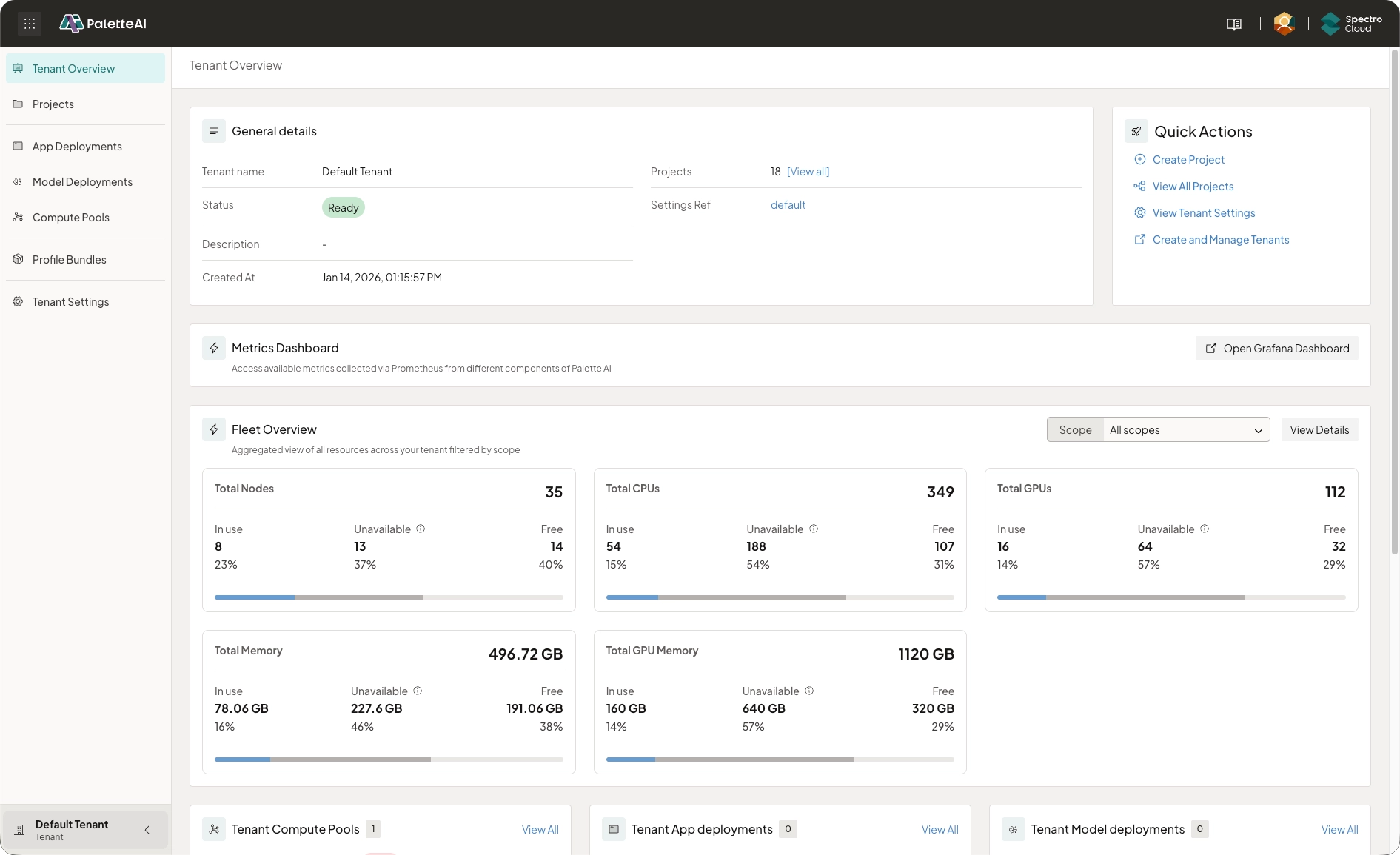
The page is organized into the following sections:
-
General details — Tenant identity at a glance: name, readiness status, description, creation date, Project count, the referenced Settings Ref, and any labels.
-
Quick Actions — Launchers for common tasks: create a Project, view all Projects, open Tenant Settings, and open the Tenant selection page.
-
Metrics Dashboard — A link to the Grafana dashboard, shown only when an administrator has set the
global.metrics.grafanaUrlHelm value. Refer to Prometheus Agent Setup. -
Fleet Overview — Aggregated compute capacity (nodes, CPUs, GPUs, memory, and GPU memory), each split into in-use, unavailable, and free. A scope selector filters by the whole Tenant, the Tenant namespace, or an individual Project, and a details drawer breaks capacity down by Compute Pool and host.
-
Tenant resource lists — Side-by-side lists of the Compute Pools, App Deployments, and Model Deployments in the Tenant namespace. The deployment lists include a create action; create tenant Compute Pools from the Tenant Compute Pools page (refer to Manage Tenant-Scoped Resources).
-
Status — An expandable table of Tenant status conditions with each condition's message and last-updated time.
Configure Tenant Settings
The Tenant Settings page is where you manage a Tenant's shared configuration: display information, integrations (Palette, Hugging Face, and NVIDIA NIMs), OpenID Connect (OIDC) group access, per-Tenant and per-Project GPU limits, Compute Configs, Scaling Policies, and Model as a Service Mappings. For the full walkthrough, refer to Configure Tenant Settings.
Manage Tenant-Scoped Resources
A Tenant admin can create resources directly in the Tenant namespace and share them with the Projects in the Tenant, so teams reuse one definition instead of duplicating it in every Project. For the sharing and access model, refer to Tenant-Scoped Resources.
You create and manage these resources at the Tenant scope the same way you do within a Project — from the Tenant's resource lists in the PaletteAI UI, or with a Kubernetes manifest in the Tenant namespace. Refer to the following guides for additional information:
- Create and Manage Profile Bundles
- Create and Manage Compute Pools
- Create and Manage App Deployments
- Create and Manage Model Deployments
Compute Configs, Scaling Policies, and Model as a Service Mappings are also tenant-scoped; you manage them from Tenant Settings.
Create and Delete Tenants
Tenants are created from the command line rather than the PaletteAI UI. To create a Tenant, along with its namespace and default resources, refer to Create and Manage Tenants. To remove one, refer to Delete Tenants. To add Projects under a Tenant, refer to Create and Manage Projects.
Troubleshoot Tenants
To diagnose Tenant readiness, status conditions, integration problems, or Tenant Settings issues, refer to Troubleshooting Tenants.